O-RADS stands for Ovarian-Adnexal Reporting & Data System. It’s a system healthcare providers use to classify ovarian and adnexal lesions on ultrasound and MRI images. O-RADS helps providers across the U.S. interpret test results more reliably and consistently. It also reduces the risk of false ovarian cancer diagnoses.
Advertisement
Cleveland Clinic is a non-profit academic medical center. Advertising on our site helps support our mission. We do not endorse non-Cleveland Clinic products or services. Policy
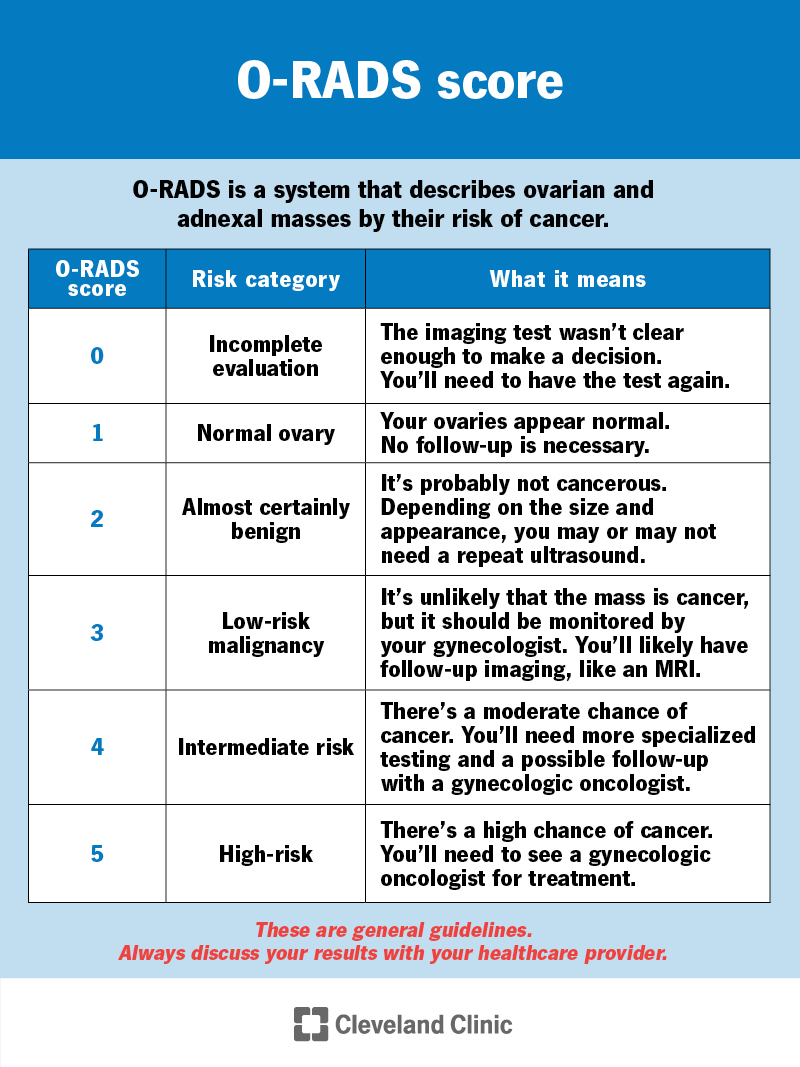
Image content: This image is available to view online.
View image online (https://nail-vitality.co/-/scassets/images/org/health/articles/o-rads%3C%21-- -->)
O-RADS™ stands for Ovarian-Adnexal Reporting & Data System. It’s a tool healthcare providers use when they find a mass on an imaging test. The tool helps them decide if the mass is low-risk or high-risk for cancer. It also helps them explain the results clearly. Based on the score, they can decide the next step. This may include follow-up testing or surgery.
Advertisement
Cleveland Clinic is a non-profit academic medical center. Advertising on our site helps support our mission. We do not endorse non-Cleveland Clinic products or services. Policy
Providers use O-RADS if they’re trying to diagnose and classify:
There are two types of O-RADS depending on the type of imaging:
Both types use the same categories to estimate cancer risk. But the criteria to assign the score are slightly different for MRI. O-RADS uses a scale of 1 (normal) to 5 (high-risk) to estimate cancer risk. In O-RADS MRI, category 0 is rarely used because MRI is usually done after ultrasound and is more complete.
Here is the O-RADS classification system:
| O-RADS score | Risk category |
|---|---|
| 0 | Incomplete evaluation |
| 1 | Normal ovary |
| 2 | Almost certainly benign |
| 3 | Low-risk malignancy |
| 4 | Intermediate risk |
| 5 | High-risk |
| O-RADS score | |
| 0 | |
| Risk category | |
| Incomplete evaluation | |
| 1 | |
| Risk category | |
| Normal ovary | |
| 2 | |
| Risk category | |
| Almost certainly benign | |
| 3 | |
| Risk category | |
| Low-risk malignancy | |
| 4 | |
| Risk category | |
| Intermediate risk | |
| 5 | |
| Risk category | |
| High-risk |
The system has follow-up care and treatment recommendations for each risk category. It also contains a list of standardized terms. This helps providers use the same words, so it’s easier to understand the results.
Advertisement
The purpose of O-RADS is to:
The O-RADS system was developed by the American College of Radiology (ACR) to improve how ovarian and adnexal masses are evaluated. It helps your provider:
Finding out there’s something suspicious on your imaging test can make your world start to spin. And if you need more tests to confirm or rule out a diagnosis, your anxiety can grow more intense by the day. O-RADS (Ovarian-Adnexal Reporting & Data System) decreases your chance of false-positive test results. It also reduces your rate of unnecessary surgery. O-RADS helps your provider — and you — get the answers you need faster.
Advertisement




Sign up for our Health Essentials emails for expert guidance on nutrition, fitness, sleep, skin care and more.
Learn more about the Health Library and our editorial process.
Cleveland Clinic’s health articles are based on evidence-backed information and review by medical professionals to ensure accuracy, reliability and up-to-date clinical standards.
Cleveland Clinic’s health articles are based on evidence-backed information and review by medical professionals to ensure accuracy, reliability and up-to-date clinical standards.
An ovarian cancer diagnosis can be shocking and life-changing. Cleveland Clinic cancer experts will help you get the treatment you need.