A robotic-assisted hysterectomy is when a surgeon removes your uterus with the help of robotic arms. It offers shorter recovery times and less scarring than other methods. Robotic surgery gives surgeons a greater range of motion that’s more precise than the human hand.
Advertisement
Cleveland Clinic is a non-profit academic medical center. Advertising on our site helps support our mission. We do not endorse non-Cleveland Clinic products or services. Policy
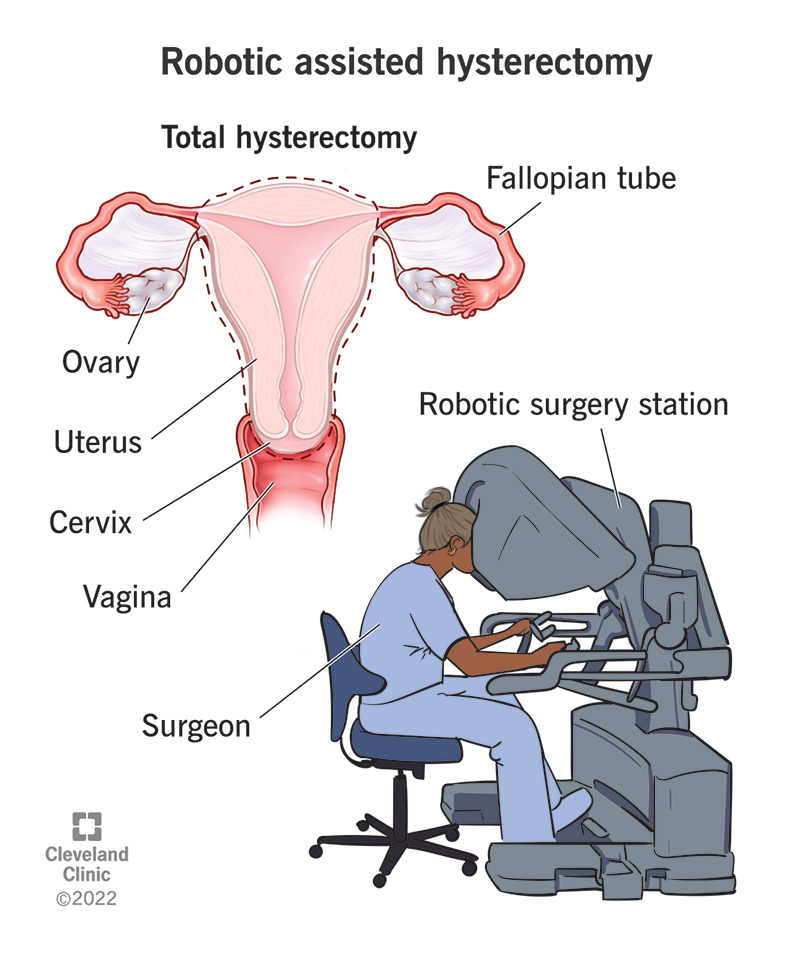
Image content: This image is available to view online.
View image online (https://nail-vitality.co/-/scassets/images/org/health/articles/21057-robotic-assisted-hysterectomy%3C%21-- -->)
A robotic-assisted hysterectomy (also called a robot-assisted hysterectomy) is when a surgeon uses a surgical robot to perform the steps of a hysterectomy. During this surgery, your surgeon controls the robotic arms from a console the entire time. They look at a screen that magnifies your internal organs instead of standing directly over you.
Advertisement
Cleveland Clinic is a non-profit academic medical center. Advertising on our site helps support our mission. We do not endorse non-Cleveland Clinic products or services. Policy
This approach may cause less pain and blood loss than open abdominal surgery. You may also recover faster.
A hysterectomy is the surgical removal of your uterus. Your healthcare provider may recommend it to treat conditions like:
A robotic-assisted hysterectomy isn’t for everyone. This type of hysterectomy may be especially helpful if you have obesity or need complex surgery. You and your surgeon will discuss whether robot-assisted surgery is possible and appropriate for you.
A robot-assisted hysterectomy is a type of minimally invasive surgery. Your surgeon makes several small cuts (incisions) instead of one large cut in your abdomen. Then, they insert a laparoscope (a thin tube with a camera) and other surgical instruments through the incisions.
The laparoscope sends images of the surgery to a high-definition video screen. Your surgeon watches the screen to do the surgery. They control the surgical instruments from a computer console a few feet away from you. The instruments don’t move on their own.
You’ll arrive at the hospital or surgical center several hours before surgery. In the pre-operative area, a healthcare provider will place an IV in your arm. The IV will help your team give you medicine and fluids during surgery.
Advertisement
After you receive anesthesia and are asleep, your healthcare team will:
In general, your surgeon will:
A robotic-assisted hysterectomy usually takes two to four hours. Most of the time, you go home several hours after surgery. But you may need to stay in the hospital overnight.
A robot-assisted surgery may give your surgeon several advantages, including:
Compared to traditional open surgery, the benefits of robotic-assisted surgery include:
Like any surgical procedure, a robot-assisted hysterectomy has risks, including:
The average recovery time after a robotic-assisted hysterectomy is about six weeks. You’ll likely be able to return to some light activities within 48 to 72 hours after surgery. It’s a good idea to have someone help you at home during this time. You may be sore and tired, and your activities will be limited.
You can usually drive within 72 hours, but this depends on what pain medication you’re taking. Most people can return to work after about two weeks. Your time away from work may be shorter or longer depending on what type of work you do.
Your surgeon will give you a list of activities to avoid after surgery. Some examples include:
Advertisement
You may have mild menopause symptoms after a hysterectomy.
Your healthcare provider will check your recovery at your follow-up appointment and answer any questions or concerns you have.
Contact your surgeon if you develop any of the following issues after a robotic-assisted hysterectomy:
Robotic-assisted surgery isn’t necessarily better than other hysterectomy methods. The best option for you depends on your health, the type of hysterectomy you need and your surgeon’s experience. Your healthcare team can explain your options and the pros and cons of each.
Having a hysterectomy can bring up a lot of different feelings. It’s normal to feel nervous about surgery or even a little unsure about having a robotic-assisted approach. Whatever is going through your mind, don’t be afraid to ask questions. Your healthcare team can explain what to expect, talk through your concerns and support you throughout your recovery.
Advertisement




Sign up for our Health Essentials emails for expert guidance on nutrition, fitness, sleep, skin care and more.
Learn more about the Health Library and our editorial process.
Cleveland Clinic’s health articles are based on evidence-backed information and review by medical professionals to ensure accuracy, reliability and up-to-date clinical standards.
Cleveland Clinic’s health articles are based on evidence-backed information and review by medical professionals to ensure accuracy, reliability and up-to-date clinical standards.
Cleveland Clinic’s gynecologic providers do all types of hysterectomies. We explain your treatment options so you can make an informed decision about your care.